2013 Interview by Rich Stevens
Link to interview on Youtube: https://www.youtube.com/watch?v=8S_c2vPFYxg
Use start button on left to hear Interview
RichStevDan.mp3
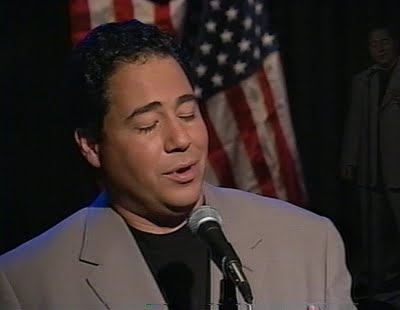
2010: Daniel Rodriguez “The Singing Policeman” Opera Singer
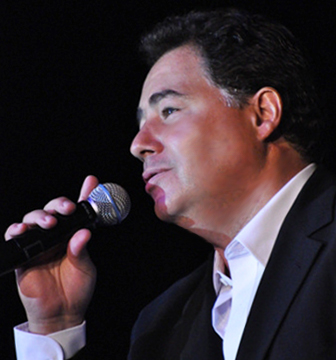
File photo (not in original article)
Interview completed by Kingsborough Student, Ruth Udoh Advanced Journalism Major
To
those who have come to love him as the “singing policeman,”— Daniel
Rodriguez was the New York City cop who helped bring America through the
hard hitting times of the September 11 terrorist attacks with his
stirring operatic rendition of “God Bless America.” After his 9/11
tribute, Rodriguez quickly rose to fame, and has had many career
highlighting performances. In 2002, he performed for the Opening
Ceremony of the Winter Olympic Games, in Salt Lake City Utah.
That same
year, he sang at the PBS Memorial Day concert in Washington, D.C. and
the Tournament of Roses Parade. He has made frequent White House musical
appearances and performed at the 2004 Republican National Convention
and at President Bush’s “Celebration of Freedom” Inauguration concert in
2005. Rodriguez has appeared on various news and talk shows such as
“The Late Show with David Letterman,” “Larry King Live,” “Live with
Regis and Kelly” as well as “Oprah.”
Currently he is on a cross country 117 city concert tour across America and has released three successful albums within the past few years. As a Kingborough Alumni, becoming an overnight sensation wasn’t something on Rodriguez’s to do list.
In the heart of Bay Ridge, Brooklyn during the 60s, Rodriguez spent most of his youth playing stick ball and hanging out at Manhattan Beach with his family.
“Brooklyn was great. An absolutely amazing place,”
Rodriguez fondly recalled.Born May 24, 1964, Rodriguez was the musical
product of a multi-cultural family, where his Puerto Rican roots fused
together with his seasoned life in New York City.
As a teen, Rodriguez spent a lot of time training his voice in an operatic style with his father, who was also a singer. He continued perfecting his singing skills throughout high school and well into his college career, which he spent at the ‘College by the Sea,’ Kingsborough Community College.
“Kingsborough was great. It had a lot of good programs, was in the neighborhood and the tuition was affordable,” Rodriguez recalled. “My family couldn’t afford the big name colleges.”
Rodriguez, a Liberal Arts Major during his attendance at Kingsborough, developed a growing interest in the field of Computer Science. He spent his free time working in the Environmental Science lab. “It was because it was next to the Early Child Care Center, that’s where all the girls were,” Rodriguez jokingly stated.
Like many Kingsborough students, Rodriguez not only went to school full time, but divided his time with work. “I earned a living working various odd jobs during college, stated Rodriguez, “I was a delivery boy, a catering chef, a cab driver, cabinet maker. Those were really tough years.”
During those often difficult years, Rodriguez’s Kingsborough journey was unfortunately cut short because he was, as he stated “thrown into the world of adulthood.” Due to a growing need to support his new born child, Rodriguez was forced to set aside his school career as well as his music career to take care of his familial responsibilities as a new dad.
“It was very arduous. I was literally thrown into the world of adulthood,” stated Rodriguez. “I had to struggle just to make ends meet and for about four years it was a big struggle to try and find out where my life’s journey was going to take me. I had to find the road that I really wanted to travel [versus] the road that I was forced to travel.”
When recalling those difficult times he experienced during his post-Kingsborough journey, Rodriguez stated some words of wisdom.
“Many times, we are forced to travel many roads because of the responsibilities we are given as adults, but it is important to remain true to our dreams so that we can go back onto the road that makes us whole,” Rodriguez stated. “My post Kingsborough journey was finding my way back to the road that made me whole, which was my music and singing; a gift God gave me.”
It was at Rodriguez's next day-job where his career began as a member of the New York Police Department. After working at a job that wasn’t going to take him anywhere, Rodriguez took his fathers advice and his former job at the US Post Office, and began looking for something more rewarding. His search led him to the front door of New York’s legendary Police Department.
“I had this sense that policemen were like Superman. I have always been a fan of police officers and knew you could always depend on them,” stated Rodriguez as he recalled his admiration for the ‘boys in blue’ as a child.
Though he was an officer in training and father, Rodriguez was still able to dedicate most of his free time to his passion of singing. “I sang at night clubs and made bookings for myself with a pianist,” stated Rodriguez. I even was part of a quartet for some time. I was a leader of songs in various churches and rehearsed and booked shows for myself over the weekends”
While balancing both lives, a friend of Rodriguez’, who was an organist as well as Detective in his department, helped elevate him within his academy. This boost brought a new found recognition of Rodriguez’s singing talents to his fellow officers.
While in training, Rodriguez discovered that there was a Ceremonial Unit which performed the National Anthem at the yearly graduation ceremony held at Madison Square Garden. Determined to showcase his talents to a larger audience, Rodriguez made it his priority to join the unit.
“They usually use a cadet to perform in the ceremony, stated Rodriguez and I didn’t want to approach the ceremonial unit, so I used one of my friends to make a phone call. That’s how everything was done in the police department. If you want something, you find what we call a ‘rabbi’ and you have your ‘rabbi’ call to get you out of bad assignments and put you in good assignments. The higher you know people, the better off you are as a police officer. That’s the politics of the police departments.”
Rodriguez’s mysterious bearded rabbi stayed true to his word. Calls were made and he was given the opportunity to try out for the upcoming Graduation Ceremony. “I tried out a month before graduation and they loved it,” said Rodriguez. “Before I knew it, I was at Madison Square Garden with over 2000 of my fellow police officers singing the national anthem and then I became an overnight celebrity.”
Following the event, Rodriguez
was assigned to the police department's ceremonial unit, where he began
singing the national anthem at many official ceremonies and civic
events. He performed for Mets and Yankees, two of New York’s most
popular major league baseball teams and was personally called up by
Yankees owner, George Steinbrenner, to sing at the World Series game
against the Diamond Backs.
Rodriguez was regularly flown to the White House to sing for the President and was becoming known for his unique operatic style and his kind humble spirit.
“I had more connections in the police department than the police commissioner,” Rodriguez stated in a jovial tone.
His road to success took a sudden detour on a day no police officer in New York City could ever forget.
“I was at ground zero when the towers came down, stated Rodriguez. It was sheer terror and there were moments where I made my peace with God because I was sure these were the last moments I would live.”
Rodriguez’s voice became more reflective.
“One of the things I realized was that all my life, I had been a singer and that was my first love and passion, but at that moment the only thing I wanted was to be by the side of my fellow officers doing my job at Ground Zero,” stated Rodriguez. When the second tower came down, I honestly thought everything was going to end.
At that moment I asked myself ‘Have I done enough in my life? Have I taken every opportunity to do a good deed to help another person?’ “My answer was, I don’t know. I wasn’t sure. From then on I made sure to spend my life being a positive example to the people that I meet by using the gifts that God gave me. My outlook was to do things to the fullest.”
After September 11th, 2001, Rodriguez’s voice became a symbol of hope, and healing for New York City. Some weeks later, Rodriguez sang what he describes as his most memorable performance ever.
“It was huge, stated Rodriguez. Oprah hosted. James Earl Jones read a poem. Bette Midler sang “Wind Beneath My Wings” and my soon to be mentor, Placido Domingo sang the “Ave Maria.”
The September 11th memorial performance set off a chain of events, including an invitation for an audition with Placido Domingo that forever changed his life. The brief audition, held at the Met, led to 18 enriching months of opera training with Domingo. Rodriguez’s dreams were materializing in reality.
Since then, he has performed his most notable role as the Clown Canio, in the dramatic opera Pagliacci and also performed at other various high profile events both nationally and internationally. As his success as a singer grew, Rodriguez decided to hang up his uniform and officially retired from the NYPD in June of 2004, to pursue his music career full time.
“We are the conductors of our own symphony,” declared Rodriguez. “You have to ask yourself the question: How do you want your life to be? What is the work that you want to conduct? And how are you going to make it happen?”
When summing up his Kingsborough experience, Rodriguez stated, “The experiences I had in Kingsborough helped me to grow and gave me what I needed in life. It was the idea of not completing my education, which made me realize that I need to complete the things I love. If I came back, I would love to share all that I’ve learned by mentoring students at Kingsborough. Now that I’m older and wiser and can look back at things, I strongly believe that our gifts are the sums of our experiences.”
RG: Rabbi Gelman
FH: Father Tom Hartman
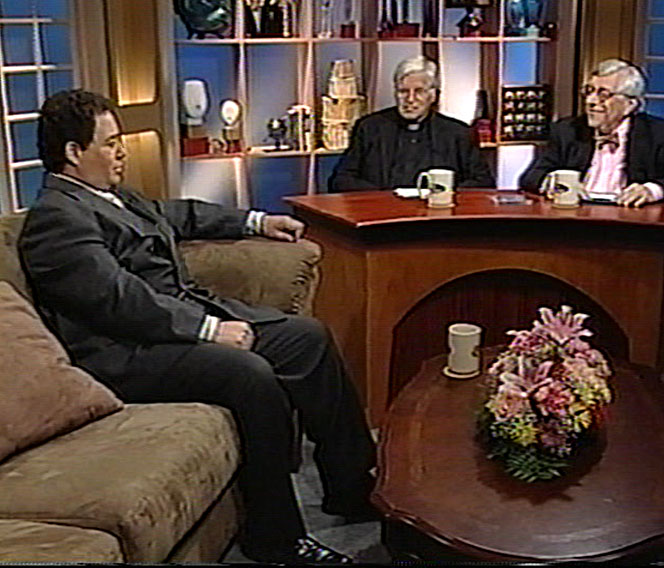
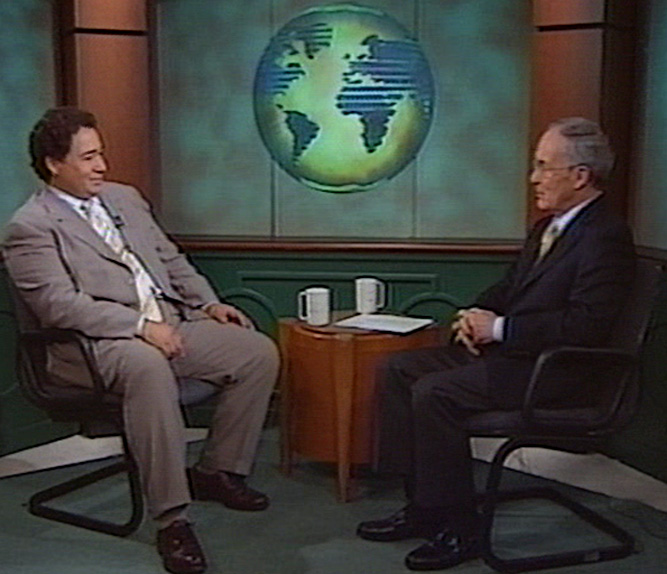
FH: Today on the God Squad, we're happy to have joining us, America's beloved tenor, Daniel Rodriguez.
RG: Ladies and gentleman, from his new album "In The Presence," this is "On Eagles Wings."
Daniel sings.
FH: Most of us know our guest today from his Heavenly voice, the voice that helped to comfort us in the days and weeks after the tragedy of Sept 11, 2001. He's a former New York City Police officer and he has just released a brand new CD entitled "In The Presence." He is of course Daniel Rodriguez. Welcome Daniel.
Daniel: Thank you very much.
RG: Daniel, I never had a chance to thank you personally, but at the time of 9-11, I was the President of the New York board of Rabbis and therefore I was asked to be a part of the song for America-the Prayer for America on Sept 24th at Yankee stadium, and I was so upset. Tommy and I had done- I don't know-20 or 30 funerals that week and of course, not one body, just thousands of grieving people. We were at the edge, really. We were at the edge of our capacity to just go on. I've never been so spiritually broken and there were lots of nice speeches and sermons and lots of good stuff in that service. But it was your voice, your voice that healed me and gave me hope and returned me to the feeling that no matter how broken I felt at the moment, things would work out and It was not only the greatest song of that service, it was the greatest prayer, and Thank You.
Dan: Well thank you. Ah, I was at ground zero when the towers came down. I was working that day.. you know all my life I've been searching for a career in music you know since I was very, very little doing shows where ever I could, in the theater. Thousands and thousands of people must have heard me throughout my life, you know performing. And it was on that day that I think the realization came to me that all these years you've been given a gift and you've been preparing for the time when in God's time, you would do the most good with what he had given me. And.. I remember that day, and I remember thinking that It's not a career that I was seeking, but this calling to be able to share the music, to be able to feel the songs and to internalize them and to make them my own and then to give that back to the people who were listening. And that day was the culmination of many many years of everything that I had done. My healing began as well.
RG: God Bless you
Daniel.. Thank you..
RG: Tell me, tell our audience what kind of training you had to sing, what voice training you had, what experience you had in doing...
Daniel: Well I studied since the time I was 12 years old with Elliot Dorfman who was my music teacher in Brooklyn: Dewey Junior High School. He also had a theater company in Manhattan called the American Youth Repertoire So I became part of that company and for about 8 years I was doing musicals and doing drama in the theater - growing up in the theater. But I started a family when I was 20 and music had to take a back seat..
RG: ah, you took the police exam...
Daniel: Police exam - my father said, "You gotta get a job with benefits." So the post office called me..
RG:. How many years did you put in?
Daniel: I did 6 years with the post office, and then when the police department called me, I did 10 years with the police department. But all the time that I was working I was still singing. I had my own show/ I had a quartet that would go around and do the churches, the Bar mitzvahs, the synagogues. We did a lot of work around the city. I was very very content, that fact that I was sharing my gift. I was doing what I loved to do and I still had a day job. When the police department called me, they asked me to sing the National Anthem at my graduation ceremony. I was a trained opera singer for the most part. They made me the official national anthem singer for the New York PD, which again paralleled my career with my passion-my love.
FG: The CD that you have "In The Presence" seems to suggest a spiritual tone.
Daniel: Absolutely, absolutely. Every CD that I've done so far- "The Spirit of America," "From my Heart," all have a song of faith on them. In the first one, was "The Lords Prayer" and "The Ava Maria," and the second, was "I'll Walk With God," and this one, when I decided to record this CD, I decided that I was going to do an album of music to really give the people my belief in my faith, in music, through music. "In The Presence" was named- titled because I felt that whenever, when I was singing, when I was preparing these songs, I placed myself in the presence. I said how would I perform this as I am in that..picturing myself standing before God, picturing myself singing this music,, and I think it's a really great, great CD.. we have a .. Johnnie Carl from the Crystal Cathedral who passed in December. We lost him in December. His arrangements are on there so... it was just a great collection of music that I'm very proud of..
RG: We'll continue our chat with Daniel when we return, but before we go lets have Daniel sing a song from his new album, its one of my favorites, "Ave Maria."
RG: Our guest today is former New York police department officer and well known tenor Daniel Rodriguez. His new CD is titled "In the Presence" and it's available at music stores everywhere now.
RG: Daniel, the only thing we share, since I can't carry a tune, is we're both...all of us are put in the position, Tommy and I, from saying the same prayer over and over again at one after another service and you basically singing the National Anthem a bazzilion times. We all have the problem, and I guess our viewers would have it in the things they do over and over in their work and the challenge is how do you make repetitive things, repetitive tasks exciting, fresh each time?
Daniel: Well I think when I sing, it is a problem because now I do a lot of work around the country, where at one time I might have been singing a song, 7-8 times a year, now I'm doing it 7-8 times a week. But as with anything else our passions are what they are, you know yourself and of course Monsignor, and every time I perform I try to realize, I try to think that what I sing is going to be interpreted by those who are listening and if I interpret it poorly or I sing it poorly or it I don't put as much in each time, then the message won't get across. Songs like the national anthem, God Bless America, are easy enough to give passion to, it's the other things, when you are doing things that are more everyday, that are more difficult. But it's just a matter of placing yourself, I guess, in the song and in that place where you want to take the people to, when you sing.
FH: We're all familiar with 2001, but you've appeared in other venues to give people strength and that.. What are some of those venues?
Daniel: I was at the 2002 winter Olympics, I sang God Bless America, I've done a lot of work 9-11 related work, even today. Memorial services, dedication ceremonies, memorial walls that have been in preparation and have just gone up, where we were together recently at one of those memorial services. I continue to try to do positive things. For me it's pretty simple.
FH: What questions to people ask you?
Daniel: People pretty much want to know where I'm going, what I'm going to continue to do with my career.
FH: About the Twin Towers?
Daniel: They do, a lot. I'm very connected to Sept 11. They ask my story almost at every venue. They want to know how I felt or where I was. What were the things that I was going through. And I tell them freely, because again, it's a way of continuing the healing.
RG: What is the greatest life lesson that you learned from 9-11, and that you took into your life.
Daniel: I think the greatest lesson that I learned from Sept 11, was that no matter how different we seem on the outside, inside we're very much the same. When we shared that large Prayer for America, where all different faiths came together from around the world, even Muslim faiths, they all came together. Fundamentally we all seek the same happiness. It's the radicals that are destroying or that are hurting, but for the most part, the world is a good place. And my motto is just hoping that I leave it a little better than I found it, with my music and with my positive energy, my positive attitude. Let's face it, my career stands for something that came out of a tragedy: something positive that came out of a tragedy, and it's a responsibility to live that way.
RG. That's wonderful. Thomas, what did you learn from Daniel?
FH: Well. the first thing that stuck me, I said it to you, right before we came into the studio. I said the word Enthusiasm, comes from in theos. is God in Greek. I wanted to say that to him because I experience his enthusiasm, and his passion, his love, his patriotism, his commitment to thinking about faith as part of the equation, and your smile and your kind eyes. So I wanted to say that I think what you're doing is in God.
Daniel. Well, thank you.
RG: Is there some place that you'd like to play that you haven't yet?
Daniel: Ah actually there are so many places around that I'd love to do. I haven't done a Broadway show and I haven't done a full opera, and those are some dreams of mine to do. So I hope to be able to do that.
RG: Oh that would be wonderful..
Daniel: Someday to perform at the Met perhaps. But I just let myself be led. Most of my life has been pretty much having the courage to walk through the doors that Gods opened for me. So I just continue to have the courage, to whatever comes my way, you know, take advantage of it and move in that direction. Positive, forward.
FG: You know when you live that way you just have to get out of the way so that you don't ...
Daniel: (Laughter)..that's right! Get out of my own way...
RG: Get out of God's way..
Daniel: Yea.
RG: I think it's true that of most people who've experienced what you have experienced, the kind of life changing mission and new way to continue on, that really if they're just quiet and listen. And ask themselves what does this mean? Its clear. It's clear what it means..it's when you're all agitated and not quiet and you're not listening that you miss the message.
Daniel: That's absolutely true and I found that so much of my life has been looking for a prize and not enjoying the ride that God has...you know...the analogy that I'm just a passenger, God does the driving, and I get to enjoy the ride. It's so true, everyone of us has the same.. we all go from point A to point B in life. What we do in the middle, what we do in-between, the positive things that we leave, is the mark that we leave on this earth and for those of us with faith, all those things that we do to be more God- like is a positive force moving forward. That's what counters all the negative that's in the world. Just one man being positive.
RG. So folks, you can't share his voice, but you can share his heart.. We need to take our final break, but before we do, here is Daniel once again with his version of the classic, "Amazing Grace."
Daniel sings..
RG: Daniel, I want to thank you, that was extraordinary, it's obviously been a pleasure to hear you sing, but it's also been an honor to hear you sing.
Daniel: Thank you very much.
RG: And God Bless you and may God protect you and cause you to thrive in your work;
Daniel: God bless you both..
RG: Thank you..
Well, let's not forget Daniel's CD. You can have his songs with you everyday. "In The Presence" and now at the end of the show... I wish it didn't have to end. But it is joyous now for us to be able to hear Daniel Rodriguez singing "God Bless America."
I'm Rabbi Mark Gelman.
I'm Father Tom Hartman.. We're the God Squad.. God bless you!
Daniel sings "God Bless America."
Contact to inquire about purchasing this interview on DVD: http://telecaretv.org
Daniel Rodriguez gained national recognition as the singing policeman after performing at many memorials after the events of 9/11. Since then he has studied with Placido Domingo and released 3 successful albums. His most recent CD is a collection of spiritual songs entitled "In The Presence." Before we visit, Daniel is going to grace us with a performance of the beloved classic, "How Great Thou Art."Daniel Sings "How Great Thou Art."
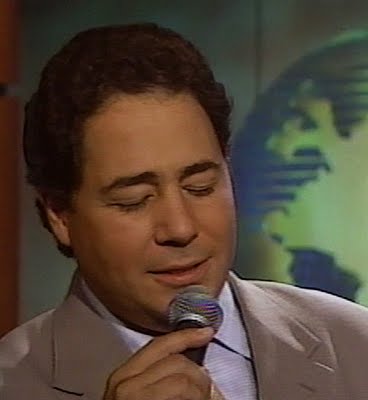

DH: Welcome back to Christopher Close-up. I'm Dennis Heaney here with Daniel Rodriguez. Daniel that was beautiful!! In the presence is the 3rd CD. What was the inspiration for this album?Daniel: Well, all my life has been based on faith since I was a little kid singing, as leader of song in church, even the last 2 albums I did had a song of faith on them. The first was "God Bless America" with "The Lords Prayer" and the "Ave Maria," and the second was "Ill Walk With God." that Mario Lanza did from the "Student Prince." So everything was based on faith and this album for the most part I believe, it was a time when I need to express even more of that faith and the Crystal Cathedral was a big influence in walking that path. Johnny Carl of course. So that was the influence, it was time for me to share with the world what I really believed in -- what I felt -- my spirituality.DH: Well, we're the richer people for it. You dedicate this album to Johnny Carl and to Concepcion Padilla. Can you tell us a little bit about these two people?Daniel: Sure. Johnnie Carl of course was the conductor at the Crystal Cathedral, who was conducting this album, and I had sung on the Crystal Cathedral some of the songs you hear on this album like "How Great Thou Art," "Amazing Grace" and "On Eagles Wings." Johnnie of course was called home in December, when he lost a battle with mental illness, and so I dedicated the album to Johnnie Carl because his arrangements on the album are tremendous! No one does an arrangement like Johnnie Carl. We think because he was in the Crystal Cathedral all his arrangements are so huge to fill that big space.... and then of course Concepcion - Concha, my aunt. She became very very ill last year with cancer and my mother went down to Florida where she lived to take care of her, and during the whole making of this album she kept saying "when am I going to hear something." And in the final days -- the last hours actually -- she passed on Holy Saturday, and on that Friday I came to the house with a rough CD and played it for her. She hadn't had many reactions at that point because she was in her last moments but she smiled. She gave her approval of the music. A woman who was devout her entire life. My inspiration of faith came from my aunt Concha - Concepcion.DH: Well, it's evident. The faith that pours through in this album is so palpable, I think the music becomes so.... The story of Daniel Rodriguez becoming America's singing policeman, is such a fascinating story. I think at 13 you were in The American Youth Repertoire. Talk a little bit about that experience -- at 13 years old?Daniel: It started in school when a teacher heard me. I auditioned for a talent class. He said "you have some talent, why don't you .. when you come to school you'll be in the theater arts program." He had a company, the American Youth Repertoire Theater, which I soon auditioned for and became a part of that company. I was doing drama, dramatic plays for the most part - acting. Singing didn't come until about 14, maybe the next year. When I did my first musical.. I had done musicals in school, but in the theater I had only done dramatic parts, so at that point he said "I want to train you to sing. You have a good voice I think you can be a great baritone." He went to talk to my parents, because in those days.. you know my parents being Spanish, said "who is this guy?" But they wanted to give me the opportunity to be all that I could be. So I started studying Bel Canto. It was rigorous. Tuesday was piano lessons, Thursday was singing lessons, Friday was acting lessons, Saturday was actually in Manhattan. 8-10 hours of performance - rehearsals and performance. I learned a lot because in one show I'd have a part but I'm also the stage director. The next show I'm the lighting tech, the next show I'm working the sound boards. So I learned quite a bit.. When I was 20, I started a family and I couldn't continue my career. I had to go to work. We were talking about all the jobs, as a cab driver, catering chef, short order cook, flipping burgers at Lutheran hospital in Brooklyn, just anything to put food on the table and music had to take a back seat.DH: But then the part that I find so fascinating! You believed so deeply in Daniel Rodriguez. It took a back seat but you didn't lose sight of that dream. You went through a period yet as you acknowledge "the dark ages."Daniel: Yes, the dark ages.DH: But now how did you first of all become a New York City policeman.Dan: That was much later. When I was about 24-25. Like you say, I had a passion for the music. It's always been a part of me. I never lost sight of the fact that I want to sing. I never thought about fame or anything else. I just wanted to perform, so I hired a piano player, I rented a hall, borrowed the money, dusted off all the old music, sold the tickets, collected the tickets at the back of the house because there was no money you know. I filled a 300 seat little place in Staten Island - Snug Harbor. I did a concert and I was back in the music business. I used whatever was left of the money after I paid back the loan, to do more media packages and to ship them out and people started calling. My father was one.. he worked for the city, and he said you really need a job with pensions, that is going to give you benefits. So I took all the city tests and the post office called first So I spend 6 years as the singing postman, singing postal worker. I had my own show, and people in the post office always asked me to sing when they had a party, I would entertain. So music was paralleling my life all the way until about my 30th year, when I get a letter in the mail, your tests from the police dept. is going to expire and if you want to be considered for the police. dept., send in this application. Fortunate for me, or there are no coincidences, I had been working for 10 years with on organist who was a detective at applicant processing, Edward LaPlant, He was a great organist. He said "well, Dan I can do your paperwork, but you're 265 pounds and you're not going to get into the police dept. unless you lose about 50 pounds." 6 months later at the last possible opportunity I had to make the academy, I weighed in at 211.DH: What an amazing story! Before I continue my talk with Daniel Rodriguez he's going to do one more song from his album "In the Presence."Daniel sings. "An American Hymn."
DH: Thank you for another beautiful number Daniel! Most of us got to know Daniel Rodriguez after the tragic events of Sept 11th. But before that you were New York's singing tenor, Policeman-tenor. Talk about how you came to sing God Bless America for so many of those memorials.Daniel: Like you say, before 9/11, I was doing a lot of things in the city, I was the official national anthem singer. Sept 9th. I was singing Broadway on Broadway on times Square, for the third year in a row.. and that summer I did... CNN did a huge thing with me being a police officer during the day and then going to Carnegie Hall to sing with the New York pops at night, which I actually saw on one of the airlines when I was traveling. It was really strange..but Rudy Giuliani was at one of the performances, He's always been a great supporter, and when Sept 11th occurred, I was working ground zero and shortly there after at "Prayer for America" which was in Yankee Stadium, came and asked me to sing. So that began where I am now, the roller coaster ride that's taken me to where I am today.DH: You actually spent time as a New York City police officer at ground zero.Daniel: Yes, I was there for a couple of months, you see the thing is even when I was called to sing, I didn't go back home, I went back to ground zero. So for the first couple of weeks I was in ground zero at the command post where the morgue was set up and I was working there. We were there day and night. When the first call to sing came I went from Ground zero to perform and then back to ground zero. Everything there after, all the different talk shows that I was doing, Regis, Letterman, Larry King live. I would go to the shows and then back to ground zero. so for me it became a real emotional roller coaster you know you have this elation of being on Regis or these shows and then you go back to the reality of why you're doing what you're doing. And I think that was God's purpose. It reminded me that this is not a career that He has granted me: this is a calling. You're not a rock star, you're not a pop star, you're not a Broadway singer. You know at that point in my life I was a vessel, a messenger that was trying to bring some positive news to a horrific time. So it kept me very grounded.DH: You talk a lot of about that if I may say. You talk about your music being a ministry.Daniel: Absolutely.

DH: You talk in stories I've read and then now again today about that this is a gift from God that you feel called on to use to praise the lord if you will. Tell me a bit more about this ministry concept of your music.Daniel: All my life I've been led. Concepcion my aunt, once said, "God has a very special plan for you." And this was when I was very young, and all my life, even through the dark ages, I always knew that I was going to be all right and I always felt myself let through my life. There was always that faith you know. I sang for hundreds of thousands of people before 9/11 in the shows that I would do every weekend and for the most part the passion of singing was always there. But no one ever said, that voice should be famous, lets get him at the Met, let's do something with that, and I believe that's because that wasn't what I was meant to do then. What I was meant to do was to prepare my life for the moment when my voice could do the most good, can bring the most good and that was Sept 11. That was "Prayer for America," where singing not only helped the nation, but helped me. I needed healing and that was the only way that I could find some comfort in my own soul was to sing those feelings, to sing that praise, to cry through my music, and at every funeral I stood firm because I knew I was singing for the family. I had to be strong for the family, but inside my heart broke every time I sang. That was the way I dealt with 9/11.DH: The Christopher's since our founding 60 years ago have lived with the idea that each of us has been given a gift -- a unique role by God to carry forth in the world. And I think that your aunt Concepcion must have been part of our work, our ministry, because to say that God has a unique roll for Daniel has really proven itself, especially since 9/11.Daniel: It has.DH: Placido Domingo has been a big influence and a strong part of your evolving musical career. Can you talk about the almost serendipitous way that he came into your world..Daniel: I started to mention it before. It was actually mayor Giiuliani who said "you should be at the Met," about a year before Sept 11th. He actually got me an audition, but like I say it wasn't meant to be. I wasn't prepared. I went to the Met. It was horrible! I started to sing and the person who was auditioning me..like one note. I was like "Laaaaaaa " and he said "NO, no, no, no...the La must be, the ah and the O must be.." The cop in me came out and I said, "Do you want me to finish this song or not?"DH: Laughter.Daniel: Placido heard about it and he talked to mayor Giuliani and Placido said "I'll listen to him." And for the next year and a half I tried to get to talk to him. He was always somewhere else: in Europe during the summer... so it was during Prayer for America that I walked up to him. I saw Placido, you know one of the greatest voices. I said "Mr. Domingo, my name is Daniel Rodriguez, and I've been trying to sing for you, to meet you for about a year and a half now." He says, "You don't need to sing for me, you're doing wonderful yourself."Daniel: But he did give me an audition. He did listen to me, and the same day that the Yankees won the pennant, I was at the Metropolitan Opera, I sang "Be My Love" and "Che gelida manina," from Puccini's "La Boheme" for Placido. He invites me to study with him in Washington and then that night I went to Yankee stadium and sing The National Anthem and the Yankees win the pennant. It was a great day. A great day!DH: That one that goes on the calendar!Daniel: Yea, a really great day!DH: Besides Maestro Domingo, who are the personal influences in Daniel Rodriguez's life.Daniel: Well I always say Mario Lanza, as far as the passion of the man and watching Mario sing in movies. But I think above them all, you know, shame on me for not mentioning it often enough as I should. My grandfather Raymond. He had a tremendous tenor voice, a beautiful tenor voice. My father is also a singer, my father sings. My family was very musical, but I remember as powerful as it was to see Mario Lanza sing in The Great Caruso, or to see Placido Domingo sing "Cavalleria Rusticana" or to see any of these wonderful tenor in their highlights, even to see Pavoratti doing "Nessun Dorma" -- was my grandfathers 75th anniversary, paralyzed on one side, not being able to walk, got up to a microphone in a basement and sang a Spanish song, Christmas song, and me being in awe of the man's voice. So he was the first. All the others come second.DH. That is just great. Your talent is really such a gift to all of us. We thank you for sharing it today and for all the years to come.DH: I want to thank Daniel Rodriguez for joining us today..for sharing his extraordinary talent, his many insights, his story of his unyielding faith, after the horrific events of 9/11, the voice of Daniel Rodriguez served as a beacon of light for a country experiencing some very dark days. Today Daniel continues to enlighten us in some very important ways. He reminds us that faith and trust in God will never fail us and success if based on determination and hard work and that being true to our talents and our callings can make miracles happen. Friends, where ever you are in your life remember you are there for a reason. Have faith that God is watching over you every step of the way. Then work hard each and everyday to make your dreams come true. Thanks so much for joining us today. Until next time, God bless you and remember, you do make a difference.Full interview may be available on VHS and DVD.Best time to phone - East coast business hours M-FMailing to international locations may be available.Check availability and prices
To order 30 minute VHS or DVD, call 1-888-298-4050.Ask for Jackie for help with orderingor email for more information: mail@christophers.org
Website for more information: http://www.christophers.org
Featured in Classical Singer Magazine April 2003
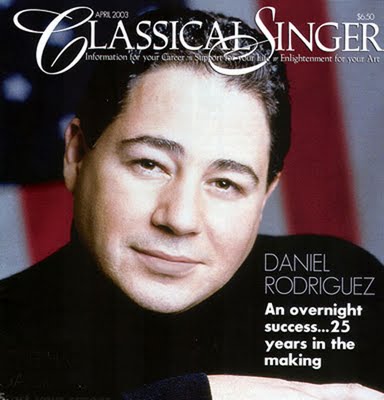
To order copies of this issue:
Check website for availability to purchase copy of this magazine.
Toll-Free phone: 877-515-9800 | Fax: 801-254-3139
http://www.classicalsinger.com/
Daniel Rodriguez: An Overnight Success ... 25 Years in the MakingYou heard Daniel Rodriguez during the dark days of 9/11; you saw him sing at Yankee Stadium during the World Series and watched his appearances on Letterman, Regis, Larry King and every other talk show. He was recently accepted into the D.C. Young Artists Program - at age 40 - paving the way for older "beginners" everywhere. He is now singing concerts all over America. Overnight success? Hardly. He's been paying dues a long time.
CS had the opportunity to see him at an outdoor concert in Park City, Utah. The voice is glorious from top to bottom, the Italian diction perfect, but best of all was his stage presence. Years of constantly working in front of an audience have taught him how to bond instantly with them - it was amazing to be a part of it. He has a lot to share with his fellow singers.Interview by C.J. WilliamsonWritten by Marsha Maxwell
Daniel: I will tell you a little about myself. I have been singing since I was 12 years old. I started singing in school. My first role was Judd Frye in Oklahoma.The drama teacher in school was a very talented man who studied at Julliard. He studied with Stella Adler and had an extensive background in theater and music. He also started coaching, and had a company called "The American Youth Repertoire Company" in Manhattan. They put on three, four, or five shows a year, and he invited me to do that. I was thirteen when I started.At thirteen, I was training musically, taking both voice lessons and piano lessons. I was in a repertory company, where you do everything, from roles to set designs, lighting: everything from A to Z. So that gave me a lot of practical experience in the theatre. I studied with my teacher four days a week.We studied many great classical singers: DiStefano, Carreras, Domingo, Pavarotti, Bjorling. The interesting thing was that my teacher thought it would be easier for me to make it in the music business if I were to train baritone.He thought that the lower range would be safer for your voice.Yes! So I was being trained for many years as a baritone. I was doing a lot of baritone repertoire - songs like "The Pride of Jean Brody." It was really nice. My first professional recital was in Carnegie Hall, Studio 856. I was billed as a sixteen-year-old baritone. The next year I went into Weill Hall and did a recital.By yourself?Yes. I sang 27 numbers, a two-hour concert of baritone repertoire. It was Broadway and operetta. My teacher did not want to bring me into the opera yet; he wanted to wait until I had more background. I had very little opera knowledge at the time. At 18, I started doing my first arias and started studying my first operatic roles. Then my teacher and I had a falling out and never spoke to each other again. I had been with the repertory company six years. We did not have an off season-we did summers-we trained, rehearsed and performed constantly. So, all I knew was school, theater and music. People ask me, "Why didn't you continue? Why didn't you pursue music? After my teacher left me or we left each other, you know, I had no clue how to sell all that I had learned.Your musical "father" was gone, and you weren't sure what to do next?Right! So I did not know how to audition. I didn't know how to go about continuing my music career, so I stopped. Started a family, and of course, I had to go to work. So there was a four year lag in my music life. I call it the "Dark Ages." The passion of music had always been in my life, and suddenly it was gone. After a while I knew I needed to pursue that passion.What kind of shows were these?I started singing with church choirs and became the leader of song for the church choir, and that took off right away, because of all those years of training. Then I met Meirislov Markov, from the Bolshevic, during an audition. I actually auditioned for the Regina Opera.The Regina Opera recognized the training, but for some reason it wasn't in the right spot, or whatever. Meirislov said, "You are not a baritone. You're a tenor. I will prove that you are a tenor. "I said, "All right."I spent three years with Meirislov, developing B flats, Cs, C sharps, and Ds.That must have been a great feeling to have your upper range open up!Well yeah, it was amazing. So now I had a dark quality to my voice, but I was singing to B flats, and people were saying "Wow!" The first show, when I was 16, was called "Twilight Serenade." When I started to sing again, at about age 25, I started my own show. It was called "Broadway Magic."I wanted to start where it all began for me, to return to that musical pinnacle in my life. I was living in Staten Island at that time. I went to Snug Harbor, which is the cultural center there. I said I would like to put on a show there. They said, "Okay."That took a lot of courage with no background except a teacher setting things up for you and church gigs!Now wait, you don't know what happened. They said it is going to be this much money to rent the hall, and this much money for the lighting tech, etc. I said okay. They said, "Do you have a piano player?" I said, "Well, not yet." I met with George Poppe, the person who played organ at the church where I was singing - a very talented man. He played wonderfully, and he always encouraged me to develop my voice. I said, "Would you like to accompany me for a for a concert?" He said, "Yeah, absolutely." So George became my new best friend. George and I actually spent the next five or six years together, doing "Broadway Magic."At Snug Harbor?Well, Snug Harbor was our first venue. I had to sell the tickets. I had to print the tickets. I had to set the lighting up.How were you making a living?I was driving trucks for the Post Office. I think by this time I had been at the Post Office six years, and I did music at night. The church gave me a lot of confidence to get back to singing. George Poppe was an excellent accompanist, and so with George I said, "Let's try some new stuff. Let's try "Maria" from West Side Story. Let's try the balcony scene from West Side Story. Let's get a soprano." The first concert, I think we spent $2,000.00, and I think we made $2,100.00, and I thought, "I can make it work."How did you publicize?I made flyers. I just put all the information in a little format that I created. For about two years I did that for every show, and at that point I was doing a show a month. We went out and started putting flyers on telephone poles, street lamps, etc. After we did the show, we got raves. The local paper did a review that said, "New guy out of nowhere, great singer." I took that review, the flyer, and the program that I printed up, and I made a little media package and took it to the next venue. I decided that churches were the best way to go, because churches had built-in audiences, and it was always a matter of faith for me. No matter what I had done throughout my life, I always knew someone was watching over me. So I was drawn to the church.I thought, "What was my first church?" Saint Patrick's in Bay Ridge. I showed them my little "media package," and I said, "I would like to do a show here." They said, "Okay, how do you want to work it out?" I think I charged them $400.00, two hundred dollars apiece for me and George, and I let them keep the rest of the money from the ticket sales. I did all the advertizing, made up the program and did the tickets. I made up the flyer and gave it to them, and they put it in the parish bulletin. We got two hundred people, and of course $15.00 apiece they made tons of money. So they were happy, and we did a fantastic show. Little by little it grew, and I said,"George let's charge a little more money, because I want to get a violinist to accompany us.So now, let's charge another $200. "George always said, "You can charge $2,000.00." I would say, "No, I don't want to go nuts, I just want to do music. We will just make enough money to have pocket change." We did these shows, and also weddings and funerals. Soon we got a cellist and a violinist, mother and daughter.So how long did you do these shows?I have been doing it for, I guess, ten years now I still do it. I never stopped doing shows even with everything that has gone on, even after I left the Post Office, became a police officer, and became the National Anthem singer for the police department. My career really started to really take off when I started singing the National Anthem in uniform.Are you taking voice lessons now?Actually, Placido Domingo invited me to sing with The Placido Domingo Young Artists Program.Now, how did that get started?I was doing "Broadway on Broadway" every year in uniform. "Broadway on Broadway" is around September 9th, every year. All the cast members of current Broadway shows come to Times Square and do a free concert. I was the singing cop. I was on CBS, NBC, ABC, Telemundo, CNN-everybody was putting me on programs. This was long before 9/11. CNN actually followed me during "A Day in the Life of Daniel Rodriguez."Gradually, as I got the opportunity to sing the National Anthem for the police department, I started to get noticed. I think people wondered, "What is this cop doing here? Who is this guy?" Even the mayor himself. I sang at the 150th anniversary of New York City on New Year's Day, about five years ago. I was one of three people on stage singing "Happy Birthday" to New York.I had started working on arias by this time, because I was very interested in getting into opera. When my teacher and I parted ways, that was the direction he wanted to take me. The music I had been doing was much more comfortable for me at the time, and fun, and so that is what I did in concert. It was easy to bring people out to a night of Broadway or a little night of music. But I did start learning arias.Unfortunately, I started learning arias without a professional teacher. I was doing "Che Gelida Manina," and I was looking down when I sang "le luna," [the moon] things like that. I had no idea what I was saying. I didn't as much study the aria as I heard it sung, and I copied what I was hearing. It went well for the most part; people that were coming to the shows were not as familiar with opera, so they thought it was perfect. The show was a great success. I did many, many shows. I was doing a circuit of churches, a circuit of yacht clubs, of social clubs.So when did Placido contact you?About two years ago I did "Broadway on Broadway." I went out and did the National Anthem in uniform, and Mayor Giuliani was coming out after me. We had spoken many times before, but this time for some reason he said, "Dan, you should be at the Met." I said, "If you can make it happen, I will go." So he said, "I am going to make a phone call. Wait for me afterwards. I want to talk to you." So afterwards we started walking, and he put his arm around me and told me about all these wonderful tenors he has heard. He is an avid opera buff. So, I got a call from the director of the Met.Joseph Volpe called you?Yes. I was painting my apartment, and I got the call. Mr. Volpe said, "You come highly recommended. What we are going to do is have a guy listen to you and see what we can do for you." I know this is an opera magazine, so I am not going to mention names, but my audition for this person was a disaster. He had already made up his mind about me. His first questionwas, "So what makes a police officer think he can become an opera singer? I don't understand. Do you sing or what do you do?"I actually said, "Do you really want to hear me, or should I just leave now?" I had prepared "La Donna e mobile," which of course I had never studied it with a teacher. I had never even seen the opera. I'd just been doing it the way I heard it in recordings. I know that the ability to hit a high C, to place it well, and to let it ring and shoot it to the back of the crowd, is only a small part of what it takes to become an opera singer. Afterwards, I thought, "Okay, so I don't sing at the Met. There are plenty of other places to sing. I am not going to stop singing."But great things often come out of bad experiences. Placido heard about the audition. Placido was at the Met, and he met Giuliani, and said, "I heard you have a police officer who wants to sing opera. Would you like me to listen to him?" Now, I know from working with him that Placido is the hardest working man in the business, as far as I am concerned. So we never got the chance to get together because of his schedule. Every month I would call. Finally it was set up for September. Then tragedy occurred. I was there when the buildings collapsed. I was at City Hall; I was on duty.I had never put that part of your story together. Of course you were involved.I was there. I'd rather not tell you all the horrors that I saw, and I relive it all the time. I went to City Hall to the command post. There was a mobile command post right alongside of City Hall. I met my inspector there, and we started heading down to Ground Zero. We were two or three blocks away when the first building collapsed. Everything after that was just horrific, just devastation.I was at Ground Zero for about two weeks, and then they were putting together the Prayer for America, which was at Yankee Stadium. It was prayer service with clergy members from different denominations. They called the police department and asked for me to sing the National Anthem.I wanted to sing, because with everything I was doing I still felt helpless. It became a kind of ministry for me to give comfort and to do what I could. You know, I found my niche. I took what I do most and do best, and I used it. At the Prayer for America service I finally met Placido; he was singing "Ave Maria."I went up to Placido. I have met a lot of celebrities, but this time I was speechless. He said, "You are the singing police officer. You have a beautiful voice. You have a very natural tenor voice." I said, "Well, we were supposed to meet. People have been trying to get us together so I can sing for you. "He said, "You don't need anyone to get us together; you are doing very fine on your own. I will be in touch with you."Shortly after that, the Yankees called me to sing for the playoffs. Placido called me to audition for him the same day. So, that afternoon I went back to the Met. I went down to one of the studios there, and he hadn't gotten there yet, so I decided to warm up. I was doing "Be My Love," and all of a sudden the door opened, and Placido said, "Who's this singer doing my song?" So I finished the song, and I think I ended it with a high C. He said,"That is beautiful." We spoke, and at that point my heart sank. I didn't know enough opera. I said, "I only know a few arias. I know 'Che Gelida Manina' from Boheme." He said, "Well, sing that for me."How did it feel to sing for him?I sang well, but once I started studying with Placido I almost felt embarrassed for the way it was presented. Placido was there and watching me intently, and I was not even thinking of the song anymore. I was thinking to myself, "Placido Domingo is looking at you, is watching you sing opera and you are at the Met," and that is all I thought about.Then the song was over (Daniel claps), and Placido said, (in the accent of Placido) "Is very good. Is very good! Beautiful high notes." Then he said, "Do you realize you go flat in the middle in the break? On the E and the F. The reason for that is you are very comfortable singing "Be My Love." "Be My Love" was beautiful, the tones were perfect, placement was perfect, but you were not comfortable singing the aria so you did not have the support." He said, "I think I can help you. I am starting this new thing called "The Placido Domingo Young Artists Program." I would like you to come. Can you take three months off of work? I want you to come out starting in March." I had to actually hold myself from jumping right out of my shoes. I said, "Maestro, Thank you so much," and I floated out of there.Then I went to Yankee Stadium and sang for the playoffs. The announcer said, "Now ladies and gentlemen, turn you attention to the mike behind home plate and our National Anthem sung by New York City police officer Daniel Rodriguez." The place went absolutely berserk. I sang the MOST heartfelt National Anthem. It was an amazing experience.I ran over to the Mayor, and I said, "Placido wants me to come to Washington." And he said, "I knew it. I knew it! You got to go for it." I said,"I am going to need your help, because now I have to take three months off of work." He said, "What ever you need." I was like, "OKAY THAT'S IT! PACK MY BAGS" I am going to heaven!" The Yankees won the pennant that day.Well, one thing led to another. The Yankees called and asked me to sing for game three of the World Series. As I was waiting to sing for the World Series, Regis and Donald Trump walked in. Regis looked at me and said, "You're the cop. I have been looking for you. You got a pencil? Write this number down." He did about five minutes on how I was a cop without a pencil. I gave him a call, and the next morning I was on "Regis and Kelly." I got a phone call leaving Regis's studio; Letterman wants you on his show tonight. I was on Letterman that night. I leave Letterman. I get home, and there is a message on my answering machine; there will be a car to pick you up at 5:00 a.m., You are doing "The Today Show" tomorrow morning, so get to bed. I do "The Today Show." I leave the "The Today Show," and then it was Larry King.Now everything has gone through the roof. I got a call from Mr. Tom Scott, of Tom Scott and the Elliot Express. Tom has two Grammys and 12 Grammy nominations: one of the premier Jazz saxophone players of our time. So I was asked to sing at the Emmys, and I went to Los Angeles. I sang with the LA Choir. It was like 350 voices; a combined college choir. Tom had a wonderful arrangement of "America the Beautiful."Tom was in the little monitor, and I was singing. I had no idea that the last "America" was supposed to go on for about eighteen measures, so I didn't hold the note, but the choir kept on singing. So Tom said, after a little consultation, "Dan, if you don't want to hold that note, that is quite all right. You can just cut it short and the choir will finish it up. I looked at Tom and I said, "You know Tom, Mr. Scott, I may never get to do the Emmys again, so how cool would it be if I nailed it?" So he said, "Okay, let's go for it." Not only did I nail it, I held it-but I think I went for two beats after they were done.That probably brought down the house! The audience went nuts. This was the dress rehearsal; it was filmed and recorded. Later, I had just gotten to the Emmys when they announced, "Ladies and Gentlemen, we have just bombed Afghanistan. The first bombs have fallen on Afghanistan in retaliationfor 9/11, and the Emmys have been cancelled."That night I turned on the television and saw Tom Brokaw saying, "Ladies and gentlemen, of course the Emmys were canceled today, but if you had seen the Emmys you would have gotten a chance to see this young man." And they showed the dress rehearsal.That night something touched Tom and called me the next morning. And Tom, you can tell what happened next.Tom Scott: [sitting in on the conversation] I said, "You touched me in way I can not describe. I have not been moved by a singer that way in I don't know how long. I cannot be the only one who feels that way. I honestly believe you have a gift, a unique gift, to give to this country." I proposed that he allow me the right to be his representative to the recording industry for two weeks. I thought about Sony Classics, EMI, Classics, MCA Classics-all the labels this guy could use. In 72 hours in New York I had appointments with all of them. It was just timing. They all knew who he was, and they all wanted to talk about him.Daniel: We got to EMI; we had a few other offers but EMI came in with the best deal. They understood that I wanted the first CD to benefit the victims of 9/11. So we did "God Bless America" as a single, which came out December 11th. ALL proceeds-mine, the recording companies-went to the Twin Towers Fund. I think to date we've given them close to $100,000 dollars.It was just a single: "God Bless America, We Will Go On."Then it was time for my album,"Spirit of America." All the songs on Spirit of America were songs that I was doing in the concerts-songs that really touched me throughout my life: "This is the Moment," "Bring Him Home," "Into The Fire," "Danny Boy,"" Shenandoah." It has been out there doing well ever since, and of course in March I started the tutelage with Placido. After the first three months, Placido invited me back. He said, "I want you to come back in August. I want to do another nine months. I think you have everything that it takes to become a major opera star." So now you know the story of my life.People ask me, "How are you handling all the fame? How does it feel to be an overnight sensation?" I say it took me 25 years to become overnight sensation!We'd better stop. I certainly don't want you to wear out your voice before your concert. Thanks so much for sharing your inspiring story with us.Daniel: You're welcome.
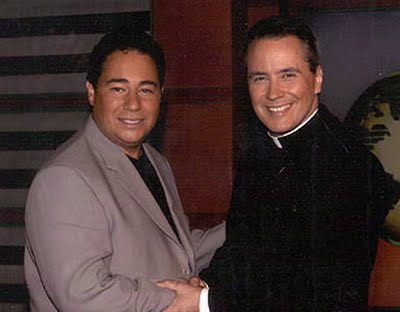
One of the most positive, most uplifting things is Daniel
Rodriguez. Many of you remember him: he's called the "Singing
Policeman," But he's much more, a great human being that we're happy to
have on the show today. When we talk about a great singer, it's good
sometimes not just to talk about it, but to listen. Daniel has a new
wonderful CD out called "The Spirit of America" and from that album he's
going to sing for us now, "America the Beautiful."
Daniel: sings "America the Beautiful"

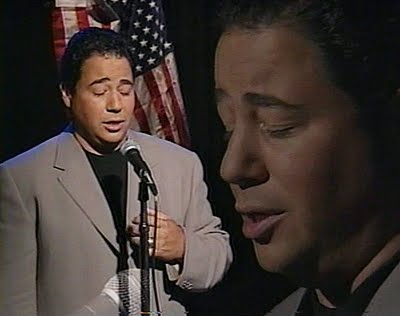
JL: Daniel, thank you so much for that. That was magnificent! I want to talk a little bit about the album. It's called "The Spirit of America" so I guess I was wondering to Daniel Rodriguez, what is the spirit of America all about? What do you sense? You're all over the place in terms of being in touch with people, especially after 9/11. What is this thing, the spirit of America?Daniel: I think what I've seen in my travels at this point in America is a tenacity, it's a sense that we are free that we fought for our freedom and we cherish our freedom. So the songs I chose like "This is the Moment" or "Into the Fire" where it speaks of courage, valor and honor: attributes that make up not only the spirit of America, but the spirit of this city, and that in our firefighters and our police officers, EMS workers, and in our youth. Our youth are growing up in a city and in a time that's tumultuous to say the least and yet we will thrive and we will go on. It's a country that's come out and said we will not be intimidated, we will not be scared into hiding in our homes. That was prevalent in the 4th of July celebration where I was around the country seeing people going out and celebrating richly, freely and it really made me feel great, it made my spirit soar to see that we didn't change what we are.JL: Daniel, here at the Christophers we have this notion that everyone is given a unique gift. And that when you're given that gift you should use it for the betterment of humanity. You were born with this, a unique and wonderful and precious gift, this terrific ability to move people with the gift of your singing. When people look at you now when you're at the top of your field, and you're well known and respected. You've had this gift for a long time but everyone wasn't knowing how great it was, and it wasn't easy to make a career around it.Daniel: No.JL: So what's it like to have the gift and you know it's good, and you know it's special and you know you can help people, how do you get it out there?

Daniel: It's frustrating when you focus on career, you focus on that type of a goal. But it was easier for me because in my youth when I was growing up doing music I had an opportunity to sing at a lot of different venues. I sang at Carnegie Hall when I was 17, 18 at the recital hall. So I had a lot of opportunities to sing for people on a small scale. And I always felt that faith was a big part of who I was and why I was doing what I was doing. And regardless of the curves that life throws you I always knew that someday God would take me to where I was supposed to be. Because whatever my purpose was would be revealed to me at one point or another in my life. And music I knew was the gift and the ability was coupled with the opportunity to use it. After 9/11 I think it was clear to me that my purpose was to use my gift in the sense for that moment to bring comfort to the city, to bring comfort to the families, to do what I had already been doing, but on a larger scale. So I continue to do that, I continue to work not just doing symphonies and doing these big concerts, but also I also do fundraisers for the Community Mayors, which is my charity, they do a lot of work with handicapped children. I still go back over to my friends over at St. Patrick's and St. Finbars and all those churches that I used to do concerts for, and I still go back to do concerts for them for fundraising. It really does my heart good to be able to share my gift now with a multitude of people and to get their feedback. I go to Salt Lake City and a man will come up to me and say, "that was beautiful, you really moved me you know. I lost a cousin in 9/11 and you really helped me through that tough time and your voice really gave us a sense of purpose." That comes from God.JL: Daniel, when people think about you, they think about this great voice and this successful musical career. I guess I'm thinking on 9/11 you were a policeman who sings. And you were also a father, and as a father how do you take two children, one in college, one of high school age, and explain to them and make sense of something so awful and evil like what happened on that day. Like how do you explain the tragedy to them?Daniel: Well it was very difficult to make sense and explain to a child, to make sense of something that's senseless. And the question you get from them is why did God let this happen? And the only answers that I could give them was that God doesn't make these things happen. In the world there are good people and there are bad people. And there's good and evil in all things and when these things happen God cries with us and suffers and feels our pain, and mourns with us, and helps us through these things. But life is life and life goes on. And God's not there to change life or make to things great, or to make things bad, God's there to help us live it. And to guide us through it. We were given freewill so some choose to use that in a negative way and thank God there are much more people that use it in a positive way. And that's the explanation I give my children, and they seem to understand that what ever we suffer through, God suffers through with us.JL: You know, you're a wonderfully honest man Daniel. I read of another interview where I guess People would immediately expected you to say well I worked in the post office first or I worked as a New York city police officer because of this noble part of the job or another.Daniel: (laughter)JL: But you were honest enough to say I had kids to support and to pay the bills. But moving back to the noble for a second. What's noble about being a New York City police officer, or being a police officer anywhere?Daniel: Well it takes a really special person to run into danger when everyone else is running away from it. It takes a special person to get up in the morning and put on a uniform with the understanding that there is a possibility that you may not come home. As remote as it might be, there's still that possibility. It takes a special person to walk into the home of man, or of a family that's going through a crisis. Police officers, firefighters, EMS, we're on the front line of everything that goes wrong in the city. And we're asked to make some sense of it and people in their need look to us as a guide, what can we do? Help me through this or give me an answer. And we have to try to provide if not an answer, some comfort or information that would get them the answer they need. And to me police officers were all heroes. When I was growing up I was always told if anything ever happens to you, you go see a police officer, if you ever get lost, go find a police officer and you tell him where you are and where you live. And to me police officers were a safety, were a guardian of the city. I knew that if anything would happen to me, if anything happened and my parents weren't able to be there, I could find a police officer and he would take me home. That's how I grew up, that's what I grew up believing. And I still believe that. You know, I've been approached on the street by people who need help or by people with Alzheimers, where do I live, I don't know where I live and I'm trying to find my way home. That's an awesome responsibility, ya know? As a child of God, I say I have to find this man's home, I have to get back to where he lives, I have to get him home. And it feels really good where I do get him home, to say here's your dad, or here's your mom. Thank you so much, oh my god, we've been so worried. You feel like you just haven't just done a job, but you've done a service.JL: Almost a ministry.Daniel: Absolutely! God said "Whatever you do for the least of my people, that you do unto me." These are his people, we're guardians, so we're given responsibility to help them. So I choose to view it as a ministry, as a guardian of the city. I really loved the job, and I really love the camaraderie of the other officers, and I'm gonna miss it. I miss it, I'm on leave now, of course God gave me the blessings to be able to study with the great Placido Domingo, and Placido has asked me to come back and continue my studies with him. So I've extended my leave for a full year, and everything else that's gone on, the symphonies, and the demands on my voice will make it difficult to put the uniform back on and walk a beat.

JL: I was thinking, if Placido thinks you're worth the effort, you must have considerable talent for him to recognize it. Let's go back to another dimension of the policeman's job though. I'm the son and grandson of a New York City police officer and I've heard this question raised before. When you're dealing with people in their crisis mode, and frankly not seeing the best dimension of the human nature either, they say it's easy for police officers to become cynical about life. You just see the dregs of humanity so often, how do you keep from getting cynical or getting down about humanity?Daniel: I don't know, I guess it's something you deal with on a day-to-day basis then you go home and see your own family. You know, you go home and you see your own family, see your own kids, you see your own mother, your own father, and the next day when you go to a home, I kind of remember them and say this is somebody's mother, this is somebody's father, this is somebody's child. There's somebody that loves this person very much and would really not take it kindly to you not treating them that way.JL: Seeing everybody as a member of somebody's family.Daniel: Sure, absolutely. As a member of somebody's family, and treating them that way. There's many times I've walked into a house, and it just works best with an elderly person, and I call the mothers, I say, "Mother, what's the problem" And I would start that way. It kind of puts them off, and even puts them at ease. You know, "What can I do for you mother? Anything you can do to make the public feel more at ease, and to make them know that you're sincere, because all the people want is to know that you're sincere about coming to help, and coming into the door, and even something as simple as a car accident. What happened, are you ok, and how can I help you? Do you need an ambulance? Just that want and that need to render assistance, is what people are looking for.JL: We're here talking with Daniel Rodriguez talking about his career and his values. We have a message from our friends at the Christophers. Let's listen to it.JL: Welcome back to Christopher Close-up. Daniel Rodriguez is our quest. Daniel, Tom Scott is a great producer of music, producer in fact of your album, interestingly enough even though he's worked with so many notable people, he said in one interview that of all the talent he's had to deal with that the most compassionate man he's met in this business is you.. I guess I'm wondering what's the source of Daniel Rodriguez's, not only talent, but compassion.Daniel: I came from a family that was very very close, very supportive. My mother and father had 10 brothers and sisters. It was a big family, so I grew up in a very loving environment. The grandparents were like the matriarchs of the family and on the holidays everyone went to the grandparents house and we all got together. So I really had a strong sense of family and a strong bond with people and I don't know. Throughout my life I've always considered myself a man of faith and I've always tried to live my life that way, it's not always so perfect but I do my best. I feel a very tender spot in my heart for people and you know for the world. it's hard to describe why I am the way I am. But I love what I do, I love life and I love living it and I enjoy the blessings I've been given. Everyday to me is just another great opportunity to go out and celebrate. Celebrate life.JL: Yea. I like that very much. Daniel lets go back to something else that people may not know. I guess in everybody's life there are moments of the desert, you know, when we're wondering when is it all going to break for us. You've been honest enough in other places where you talked to say that you had desert experiences, times when depression and real problems confronted you. How did you get yourself out. You know, someone looks at you and they see this success.. But Iwant them to know, hey it wasn't always that easy..Daniel: It wasn't easy at all. (pause) I had a lot of curves in my life and a lot of pitfalls..ah..Let's just say I've survived my teenage years, my young adult years. (Laughter) It's a story for another day. It's just safe to say that I had a few years I call my dark years and when I came out on the other side I guess what helped me, what gave me the power to overcome everything that I'd gone through was the fact that I said to myself..I looked in the mirror one day. I'll never forget. It was after a very long weekend and I woke up the next morning and I looked in the mirror and I didn't recognize my reflection, and it scared me, you know, and I said, "this is not what you were meant to be. This is not what you were meant to do. This is not the life that you .. you know.. have been living." From that moment on - about 13-14 years ago - I've worked and strived to regaining my life and moving forward and developing what I had in my youth. That love for music, that love for life, that upward and forward momentum and I kept everyday saying that you can accomplish everything you set your mind to if you work hard enough and if you want it bad enough.Daniel: I wanted to learn to scuba dive. I had a fear of the water. But I became a scuba diver and I love it and I scuba dive today. I wanted to travel, you know, whatever I set my mind to doing I would concentrate on getting that done. I wanted to sing again, so I developed my own show. I went out there and I went to my first venue. I believe it was Snug Harbor in Staten Island. I walked up to the person and I said I can sing, I want to put together a show. I'll have a piano player, I'll do 45 minutes of music and how much is it going to cost me. I paid what I had to pay and I rented a piano, I rented a hall, I rented the music, I went there, I sold the tickets, I made the flyers.JL: You made it happen.Daniel: I made it happen. And making if happen is what we are empowered to do. God gives us the power to make things happen. We have that power. We have that within us. It's just a matter of waking it up and taking the first step. The first step is the most difficult. God guides the rest of them but you've got to make the effort.JL: Daniel, when I get up on Sunday to give a homily, I hope people in the back say they agree or it made them think. I'm not going to like or dislike what I say based on what anyone says because I have to have, I hope, an interior voice. I mentioned that in the context of when we were rehearsing and you sang a run through, and you said, well I think it's good but it's up to you guys. I'm wondering how much of your life, when your'e a talented singer is dependent on the feedback that you get and how much is there a voice in Daniel that says Dam I was good.Daniel: (laughter) Well, I think a lot of it has to do with the people. In the symphonies, lately.. all my life, I gotten a charge of just singing. Getting on the stage, doing a song, getting the people... yaaa.. it feels good. It feels really great to be recognized, to be heard and to be appreciated.. I gotten some symphonies where I tell my stories on stage. This is who you see when you come to see my shows. This is who you see. I'll tell you what I did that day and I'll put a little comical spin into it to make the night entertaining.But I let people into my life. I open the doors and I say this is who I am, this is what I am. Daniel Rodriguez, not Daniel Richard Elmargety Rodriguez. I'm Daniel Rodriguez. This is who I am, this is who I've always been, you know. Accept me for this, accept me for the gift that I share with you or not. I don't want to pretend I'm someone else. Then you don't see the real me. Then I'll always have to keep up a pretense.JL: If you get puffed up someday...who...Daniel: You can beat me up!!! (laughter)JL: (laughter) Well who in your life does that. Who can say to you what no one else can say to you.Daniel: Well I'm pretty easy going that way, but there is one man, and actually on my album I gave him credit. His name is Bill Foster. I said thank you on my album for keeping me humble. Bill is a wonderful man who is now my driver, my confident. Bill had a limo company in Staten Island, when I first started singing in little night clubs a couple of years ago, in little restaurants. Bill heard that, that something and said "you're going to be fantastic, you know you're a great guy." Bill never lost that faith, even when there were days you know I said "Bill I've been singing everywhere and nobody...everybody loves me but nobody wants to do anything, you know." Bill said, "you're going to be famous, you're going to be great." He had a fleet of limousies and ran into some hard times and was left with one car - one limo that he had to drive himself.... fell on hard times.Daniel: When all this began and now people stated calling me saying, listen we want to get you here. We're going to send a car for you. I said "do me a favor. Give this guy a call. This is my driver. He's going to be driving me." So now Bill became my driver, and we just bought a new car, and now Bill is driving around in a new suit and a new car. One day I'll see Bill with another fleet of limousines. That's what it's all about.... and Bill is always the one who says, oh you're all right Dan.JL: Folks may think that being a cop is tough, and is it. Postal work can be challenging, but I think the most challenging job I know you had was when you were a cantor in church. Now here's my question for you. When your're leading song. Why don't people sing?Daniel: They do!JL: You get them to sing?Daniel: Yes, I get them to sing.JL: Do you? You must be a good cantorDaniel: That's because I say "Ladies and Gentlemen, please join me in singing hymn number.."..and I ask them to join me.JL: So it's not just you singing at church.Daniel: No, and actually Father Chuck from St. Anthony - St. Alphonse used to say "Dan, don't overpower everybody. I want to hear the people sing." So I would start out singing and then I would back off just a little and you could hear the voices raising in the church and after a while it was so fulfilling to get everybody singing. After a while they were drowning me out. Then with some of the popularity starting to come even before 9/11. I did some newspapers, people started saying "oh he sings at our church." and then you would hear people in the audience trying to sing to me or so that I could hear them. I said the whole church was making a joyful noise and it was amazing. It was great!
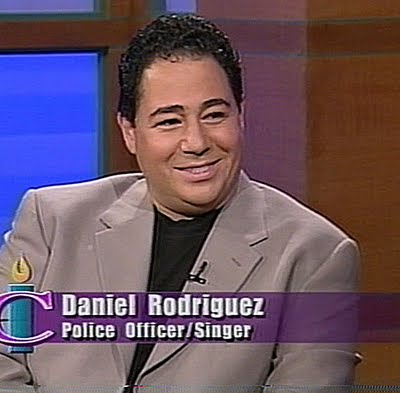
JL: I'd like to thank Daniel Rodriguez for being with us. He's a great talent, we've seen him on TV all over the place, truly a national icon in many ways. Specifically after the experience of 9/11. But I think this is a career that will go on for a long long time..JL: I guess what I love most about Daniel is what you see is what you get. This is a real person. This is somebody in some ways just like you and I, but who has taken the gift he's been given and used it to make this world a better place. He does so many charity performances because he wants to give back for the many blessings he's received. If that's not the meaning of the Christophers I don't know what is.JL: Thanks to Daniel for being with us today, thanks for the gift of his witness in terms as his work as a New York City police officer and a voice for America who can use music to uplift. I want to also thank Daniel from my point of view for his willingness to talk, what not many guests are, of faith and how faith had gotten him through, not just the mountain top experiences like now when he's popular and successful, but like all of us when he goes through the valleys, when he's been in the desert. That's when he truly turns to the Lord and says "come on, You got me here, now help me out."Daniel: That's right.JL: He's a man who is very upfront about who he is, what he believes, I'm so grateful he could come on Christopher Close-up. Thanks to you for being with us. Thanks to Daniel for being with us. I'm Monsignor Jim Lisante. We hope you're with us again real soon.
To order 30 minute VHS or DVD, call 1-888-298-4050.
Website for more information: http://www.christophers.org
